Posts

Day 8 Careersmas

Image
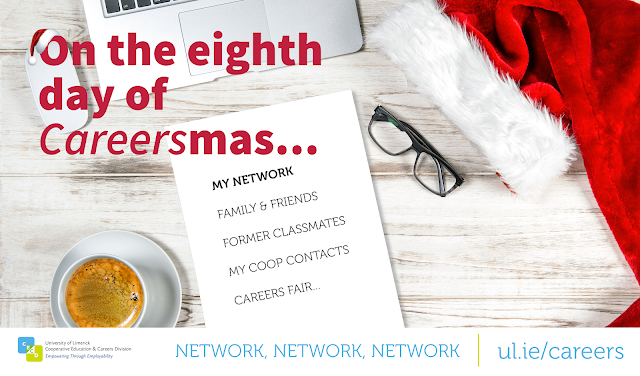
DAY 8 Careers Tip Cod e:   Santa To win a selection box - be the eight   person to DM the code to @ulcareersservice on Instagram . Not all available jobs are advertised. Some estimate that upwards of  85% of open positions are filled through networking. It is important to realise that Grad programmes are not the only show in town. These programmes get heavily marketed , everybody sees them and as a result there is higher competition. We are not saying to ignore these but you should look at a blend of applications. Many jobs are filled through personal contacts rather than advertisements. This is often referred to as the ‘hidden job market’. In order to find out about these opportunities you must do what is called a ‘proactive’ job search as opposed to a ‘reactive’ one. What is a ‘reactive’ job search? This is where your only job search activity is basically online applications. Typically, you ‘click & pray’ firstly you wait for jobs to appear online...

A little bit more on Networking......

Image
A little bit more on Networking...... Who are your contacts? The starting point of any networking campaign is to identify your contacts. Brainstorming is a good way to start identifying your networks and contacts. This exercise will help you set up an initial contact list to start your networking. The following is a list of suggested contacts: 1.     Friends/Family 2.     Relatives 3.     Sport club members 4.     Neighbours / Community 5.     Current / past part-time job contacts & customers 6.     UL Alumni that have done my course last year and the year before etc 7.     UL Staff & Careers Office 8.     My contacts on LinkedIn  Put a simple plan in place List every last contact you can think of and beside each name in a spreadsheet gather all their contact details in on place and timeline it, setting a reminder on your pho...

A little bit more on Linkedin...

A little bit more on LinkedIn... 1.     Build your professional network.  It's never too early to start building a network with people in your area. Ideally you would have a profile set up in first year and add to it throughout your university years getting a surge of contacts whilst out on Coop. Start now is the message, start connecting to classmates. While they are friends and classmates now, in the future they become business referrals. Where next?   Well how about that smartphone in your pocket? some warm leads might include your own relatives who are working in various organisations. 2.     Check out career paths.  Find people who are in LinkedIn who are already employed in your desired profession. Check out their profiles to see what they have done to become successful. See if you can incorporate something from their career path into yours. 3.     Prepare for interviews.  When you have a job interview, r...

Day 7 Careermas

Image
DAY 7 Careers Tip Cod e:   Snow To win a selection box - be the seventh   person to DM the code to @ulcareersservice on Instagram . I’d like to think most of us realise how valuable LinkedIn is.  It’s far more than a networking site with job vacancies - the site offers a way for students and graduates to explore their career options, something made even easier with the Alumni tool - find out what alumni from your course or university did after graduation. This means that LinkedIn is a networking site, somewhere to find relevant jobs and an intelligence gathering tool for career development. The latter is what we want to focus on here. LinkedIn makes creating a profile easy and intuitive but often students feel their profile has to be perfect . This mindset gets in the way of them actually using the site itself. The UL Careers Service are more than happy to advise students on their profiles (See Ultimate LinkedIn Cheat Sheet )  but we wan...

A little bit more on applications.........

Image
A little bit more on applications......... 1. Research the job For every candidate that submits an un-researched application, there will be many more who send a better one. Not doing any research will therefore put you at a distinct disadvantage.  Submitting an application form when you have not researched the job you are applying for is like sending in a note saying ‘I am not really bothered whether I get this job or not’. It will be obvious to employers if you have not researched the job and they will not look on your application favourably. 2. Research the company Researching the company will make you better able to complete your application form effectively, and to judge whether you would like to work there. What is its mission? Look on the company's website for a mission statement or marketing slogan. What are its values? Look for information about its customer service standards, for example. Is there anything distinctive about its culture, such as long...

Day 6 Careersmas

Image
DAY 6 Careers Tip Cod e:   Holly To win a selection box - be the sixth   person to DM the code to @ulcareersservice on Instagram . Now that we are into action mode - lets tackle the application form!  Application forms are widely used to recruit staff. They are also used by universities to recruit to postgraduate courses. Ultimately, the purpose of an application form is to get you an interview, whether for a job or a course . Your application form will often be your first point of contact with an employer and it is vital that you make a good impression. Understanding the types of forms and questions that you are likely to encounter, and how you might go about filling in and answering them, will help you make accurate and effective applications which stand out from the crowd. Many recruiters prefer application forms to CVs because they help to standardise applications. This can be seen as fairer because recruiters can compare candidates easil...

A little bit more on CVs

1   Length Your CV should be a two-page document: this is the market norm. 2   Font Stick to one simple sans serif font (e.g. Arial, Calibri) in point size 10–12. Simple fonts make your CV look clean, neat and readable. 3   Paragraphs/bullet points There are no strict rules here but it is good to break a CV into smaller sections. If a CV has too many paragraphs of text, it can be hard to read. Good CVs use a combination of paragraphs and bullet points. Experiment and go with what looks clearest on the page. 4   Bold Bold is used to make things stand out. But if you put too many words in bold, then none of them actually stand out. The sample CV shows you where bold can be used for real effect. 5   Design Don’t use boxes, shading, pictures or icons. Keep it simple: the recruiter will thank you. 6   Save the job advertisement Keep a copy of the job advertisement. If it appears on a website, save a copy of it onto your com...